

Public data, but at a cost: the business of case law in Spain


I am a staunch defender of Open Data. As a data scientist, it is the best way I see to foster open innovation, which can be used by everyone (and for free). And at the OpenData party, there is one guest who never arrives. A special guest.
Indeed, that special guest is the State. A public entity that possesses vast amounts of data of all kinds that could boost innovation in Spain, the emergence of solutions that improve our lives, and transparency with the State.
Perhaps precisely because of that, they release them in dribs and drabs, and not only that, but access to this data is buried under massive layers of bureaucracy and digital portals so unintuitive that it would be easier to hack the State itself to access the data than using its own interface.
I am not going to label the State as the ultimate villain; there are things they don't do badly, but overall, Spain's open data policy leaves a lot to be desired and makes access very difficult for the average citizen. And today I'm going to tell you about one of these cases, which is destroying an entire labor sector.
The problem
I already explained this issue in a LinkedIn post. Although court rulings are public in Spain, accessing all of them would cost millions of euros.
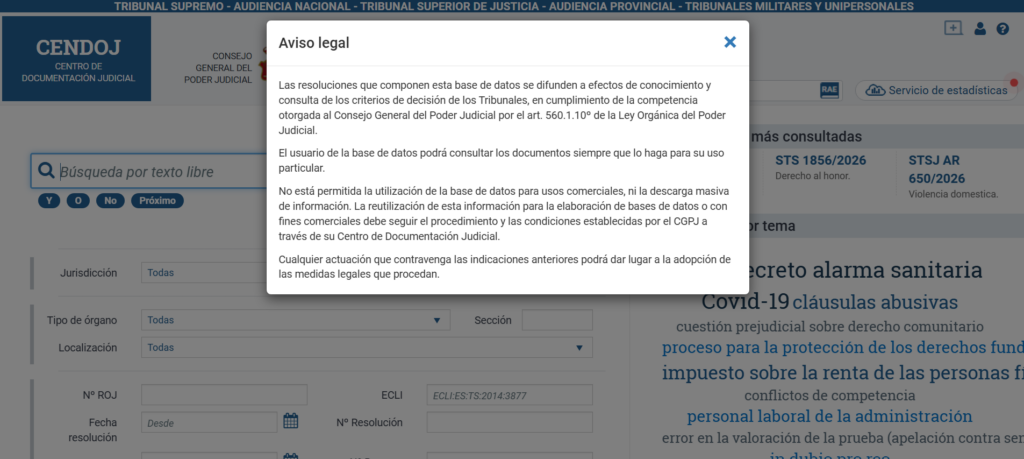
To understand this a bit better, let's go step by step. Court rulings are public, meaning you can access them. This is done through the web portal of the Judicial Documentation Center (CENDOJ to its friends). Obviously, the search engine for rulings on this website leaves much to be desired (as acquaintances in the sector who use it daily explained to me), but that is a whole other can of worms we won't open today.
What we are going to talk about is what happens if you want to use all those court rulings. Or not all of them, but a reasonably high number. Well, you're simply out of luck.
According to art. 13 of the Intellectual Property Law, "The resolutions of jurisdictional bodies (...) are not subject to intellectual property." That is, the law expressly states they do not have copyright; they belong to everyone.
And even so, the CENDOJ does not allow the mass downloading of data. They don't have an access API, web-scraping is prohibited, and they don't offer any way to download that data for free.
Ahhhhh, money, how we love money.
And the CENDOJ is no exception.
But anyway, don't worry. You just have to dig into your pocket a little and pull out 6,141,330 euros (estimate by HayDerecho). I understand that this money must be the pocket change it costs them to give you access to the data. Because according to art. 7 of the Law on the Re-use of Public Sector Information, "the re-use of documents shall be free of charge," although in some situations a fee may be applied not exceeding "the marginal costs incurred" to anonymize and make that data available.
That's what I'll tell my clients when I charge them 6 million for an API, that it's for marginal costs. If the CENDOJ can, why can't I?
And this is the main problem, because when your barrier to entry is a 6-million-euro wall, you are clipping the wings of innovation and creating an oligopoly for the few brands that CAN pay for it.
The major publishers
To understand this market built on public data, we have analyzed how the possessing party is doing business. Now it's time to see who is putting up the cash.
In the legal world, there are several large legal publishers: Wolters Kluwer, Lefebvre, Aranzadi, Tirant lo Blanch... These companies are dedicated to organizing legal information, adding value (with expert analysis), and selling access to their "enhanced" information. And that has merit and, therefore, value. That is clear. But the problem is not what they add to the data, but that ONLY they have the data. And if you want anything more than a lousy search engine, you have to pay them.
And here I wonder... What part of what their clients pay is the value added by the publisher, and what part is access to data that by law should be free?
Because by putting up such a high barrier to entry, an information oligopoly is created, in which the CENDOJ wins (because it charges an outrageous amount) and the publishers win (because they eliminate competition and can inflate prices). And the ones who end up losing are the professionals and companies who end up paying exorbitant rates to be able to do their jobs properly.
In addition, there is a key factor that affects not only individuals but the sector as a whole. Innovation. When access to a resource is monopolized, innovation slows down, because those who possess it have no incentive to innovate and improve their products, and those who have ideas let them die faced with the immensity of the wall involved in carrying them out.
And make no mistake. These companies are jumping on the AI bandwagon, like everyone else. But they do so without real competition. Because in a race where only heavyweights are allowed to run, the speed and agility that characterize SMEs, startups, and open-source projects are wasted.
And even so, there are times when one of these fast companies decides to run despite the wall in front of them. And that is where you see who owns the track. This is the case of Emérita Legal, the company that rose among giants.
The Emérita Legal Case
First of all, it's time to introduce the protagonists of this story. They are Antonio and Yéssica, founders of Emérita Legal, a Galician legaltech with a brilliant product: a tool that ranks lawyers based on their results (cases won, effectiveness rate, ...), so people can choose based on results and not on the marketing of each firm/lawyer.
The thing is, they begin to grow and end up positioning themselves as the #1 lawyer ranking in Spain. And everything was going smoothly until the storm hit.
Late 2020. The AEPD (Spanish Data Protection Agency), at the request of the CGPJ (General Council of the Judiciary), opens a disciplinary proceeding against them for €600,000 for the massive processing of personal data. The folks at Emérita argued that there was a legitimate interest, which is regulated in the GDPR. In August 2021, the resolution finally ruled in their favor, and thank goodness, because a startup cannot pay those fines without going extinct.
But that wasn't all, because at the same time, the multinational Wolters Kluwer (owner of the publisher La Ley) sued them for unfair competition, since they were paying a lot of money to have the data, and it didn't sit well with them to see a startup without their financial muscle eating their lunch.
But Emérita Legal did not back down. They proved that they did not extract data from the CENDOJ, but obtained it from their own clients, who uploaded rulings voluntarily, and from public search engines (with data from law firms, bulletins, or legal websites), applying a filter that discarded any result from the CENDOJ.
With this defense, Emérita Legal managed to get the lawsuit dismissed in 2023, and although WK appealed, it was dismissed again in 2024. And this could have been the end of a beautiful David vs. Goliath story, in which a small startup managed to overcome the barriers of a multinational oligopoly. But no. Because when you fight with everything you have... You are left with nothing.
On April 8, 2024, Emérita Legal announced they were closing. This was 2 months before the Provincial Court dismissed WK's appeal. And this is the problem innovation faces in the sector. Because it didn't matter that Emérita Legal was right, that they had found a way to run their business legally, and that they had a good product.
It was enough for Wolters Kluwer to bury them in legal proceedings so that, despite winning, they lost everything.

"Such elegance from France"
After this whole story I've told you, maybe you're conceiving the publishers as the "bad guys of the movie." Maybe some of you think that if it weren't for them, this wouldn't happen. But you're wrong. They are businesses, and they seek to make money. They are not going to give up a competitive advantage just because. The one who truly has control over the situation and the power to change it is the State. They have made the rules of the game, and solving this problem depends on them. You just have to look a little higher, specifically towards our Gallic neighbors.
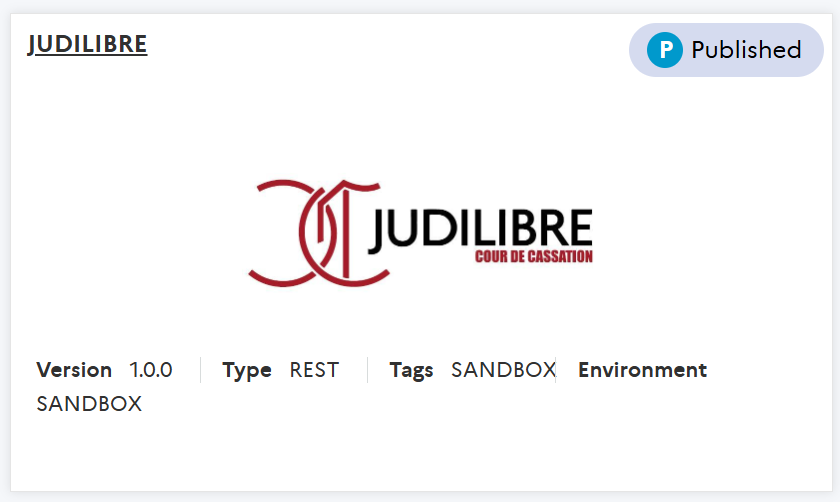
In 2019, a law was passed in France stipulating that judicial decisions are open data. Just 2 years later, the French state launched Judilibre, the OpenData system of the "Cour de Cassation" (their "Supreme Court"). In this system, the decisions of the entire French justice system are made publicly available, for free and via API. They started in October 2021 with almost half a million rulings from the French Supreme Court since 1947; in April 2022 they added all civil, social, and commercial decisions of the 36 provincial courts in France, and by 2027 they plan to have everything fully available.
Furthermore, it is the French State that takes charge of anonymizing the data before publishing it. But it doesn't end there; the software they use for anonymization is published on GitHub under an MIT license. That is, anyone can use it to anonymize their rulings (ahem ahem Spain ahem ahem).
And for those who want to try this, it's surprisingly simple:
- Go to https://piste.gouv.fr and create an account. You will have to verify it from your email inbox. Once you have it, log in.
- In the APPLICATIONS menu, open the default application called “APP_SANDBOX_<your_email>”. There you can access your Client ID and its Secret Key or your API Key, which will give you access to the rulings.
- In the “API > Consentement CGU API” menu, search for judilibre, check the JUDILIBRE - SANDBOX box, and save changes.
- Back in “APP_SANDBOX_<your_email>”, click on "Modifier l'application", go to the table at the bottom, check the JUDILIBRE box, and save changes. It may take 10 to 15 minutes to give you access to Judilibre, so stretch your legs while you wait.
With this, you could already make requests like searching by text or finding a specific ruling by ID. Below I leave the command that would have to be executed for each request using authentication with the API key.
curl "https://sandbox-api.piste.gouv.fr/cassation/judilibre/v1.0/search?query=TU_BUSQUEDA&page_size=1" -H "KeyId: TU_API_KEY"
curl "https://sandbox-api.piste.gouv.fr/cassation/judilibre/v1.0/decision?id=ID_SENTENCIA" -H "KeyId: TU_API_KEY"
Moreover, there are already open tools like PyJudilibre or DroitFrancaisMCP, which are born thanks to the availability of this data publicly and accessibly, and which exemplify the importance of the State opening its data for the sake of innovation.
Conclusion
I still remember when I made a LinkedIn post about this topic earlier this year. Briefer, less polished, but focused on the same problem. And I was left with a bittersweet feeling.
Bitter because several people were outraged. People who don't understand the importance of open data. Who don't understand that a website where you search for rulings by hand does not guarantee the accessibility required for innovation. And who view all these attempts to guarantee real accessibility as asking "to be given access to case law for free... and to CHARGE for it yourself," when really what we want is the exact opposite. That access be free, so that companies cannot charge for it, and only charge for the added value their product may have. And in this way, there are no barriers for the open-source community to design solutions that improve together and do not have that entry barrier.
But also sweet, because most of the comments were from people who took an interest in the issue and shared their opinions, more for or more against, but with a clear vision that a solution must be found. And this is what makes me trust the sector. A sector that has always been very traditional but is increasingly opening up to new ideas, technologies, and new profiles. Because until recently, only us "geeks" who like programming worried about open data, but increasingly, people are seeing the importance of accessibility and transparency of public data.
After investigating thoroughly for this article, I have looked into aspects discussed with legal professionals that have been very useful to me. I have been able to delve deeper into the problem we face in Spain with access to case law, and I have reached a conclusion. I have hope.
Because I know the mentality is changing, and we better understand what we can and should demand of the State. Because it is possible, viable, and there are clear success stories. And because I truly believe (and I say this on a personal level) that the path to a fairer and more innovative country goes right through Open Data.
Want to know a little more about who wrote this article? 👇
Career Data Scientist with a Master's in Artificial Intelligence. Co-founder of nódicus.
“Curiosity killed the cat, but not me. I am a techno-curious person surfing the wave of technological innovation we are experiencing. From time to time I upload my reflections to LinkedIn, and I also talk about how things are going at nódicus pulling the AI chestnuts out of the fire for some companies. If you like what you hear, let's talk. You make me curious ;)”